Frequency and Success of Halloween Gambit for Online Players
A scan of all Lichess.org rated games played from January 2025-May 2026 found the Halloween gambit to be rare, scary and effective, and capable of slowing Black down during the opening.
Full article, figures, and appendix: https://www.elopluschess.com/research/halloween-gambit/
Key numbers
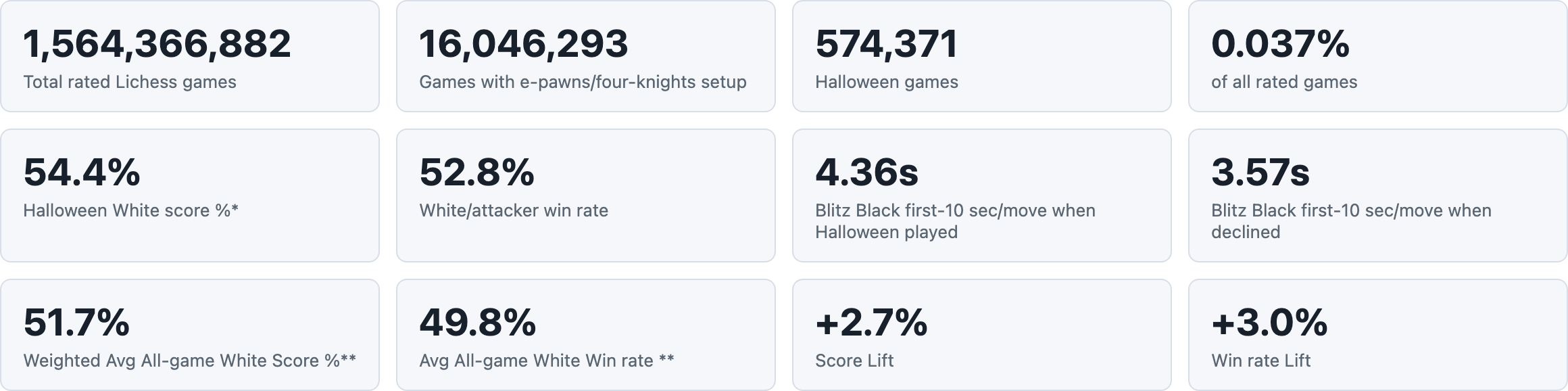
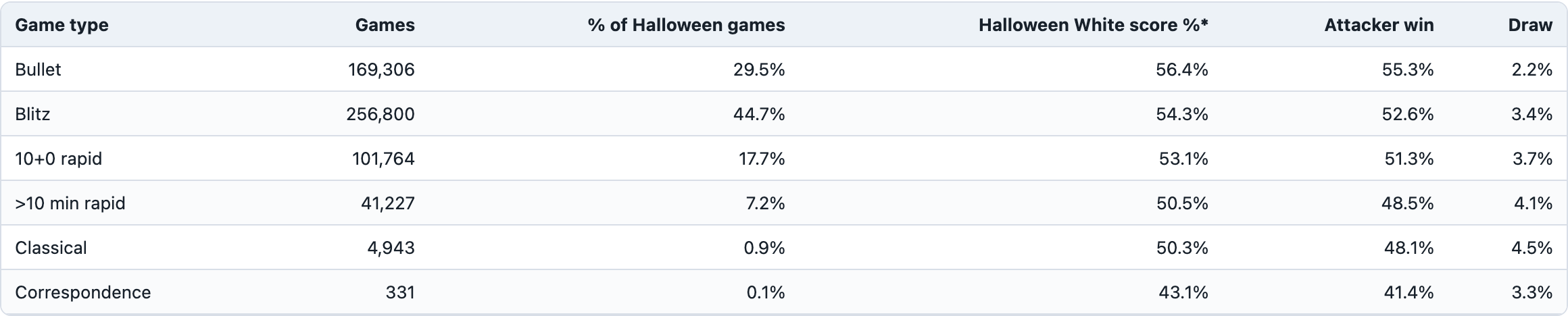
*Score % is chess scoring from the White/attacker perspective: win = 1 point, draw = 0.5 points, loss = 0 points. So Score % = win % + 0.5 x draw %. Win % counts only wins.
** All-game White scores and win rates were calculated separately by game type and 250 point Elo buckets. The weighted average then used the same relative weights from Halloween game relative frequencies.
Headline findings
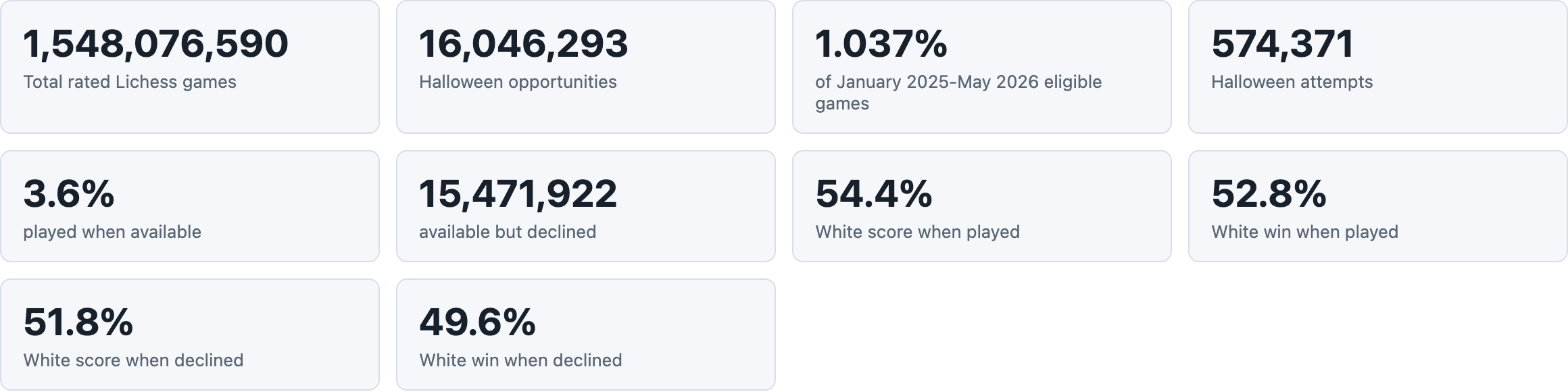
- 574,371 non-bot Halloween Gambit games found, 3.7 for every 10,000 games played.
- White, the Halloween side, scored 54.4%: 52.8% wins, 3.2% draws, and 44.0% losses.
- Baseline White win rate for a comparably weighted sample was 49.8% versus 52.8% with the Halloween Gambit, a +3.0% gap.
- For games with the same e-pawns/four-knights setup where the Halloween Gambit was available but
Nxe5was declined, White scored 51.8% (2.6% gap) and won 49.6% (3.2% gap). - Black averaged 4.52 seconds per move over the first 10 Black moves when White played
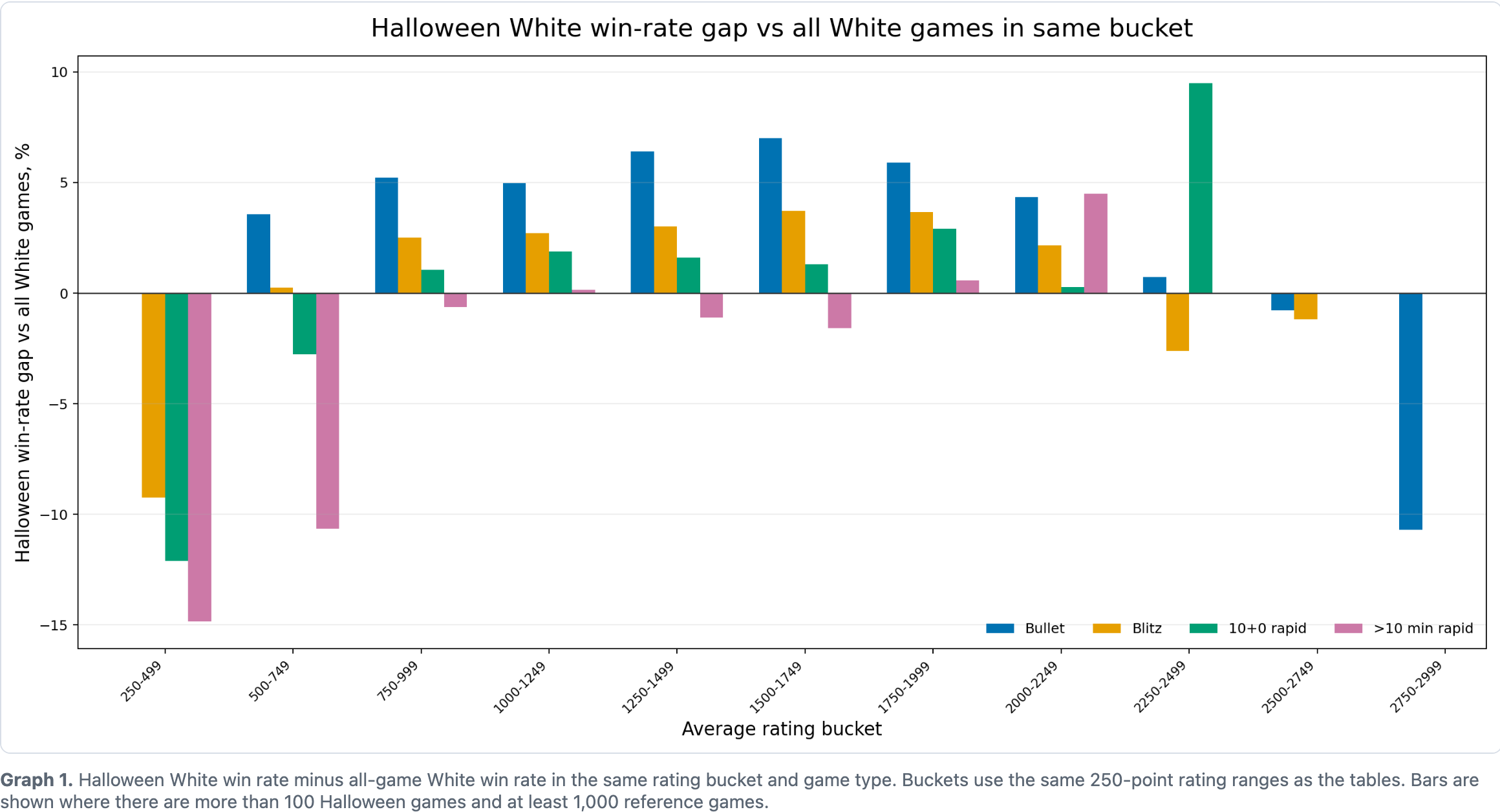
Nxe5, compared with 4.08 seconds when White declined it. White timeout wins were 13.7% when the gambit was played versus 13.2% when declined. - The largest positive lift appears in the faster game types, especially bullet and blitz, and most clearly across the 1250-1999 average-rating range.
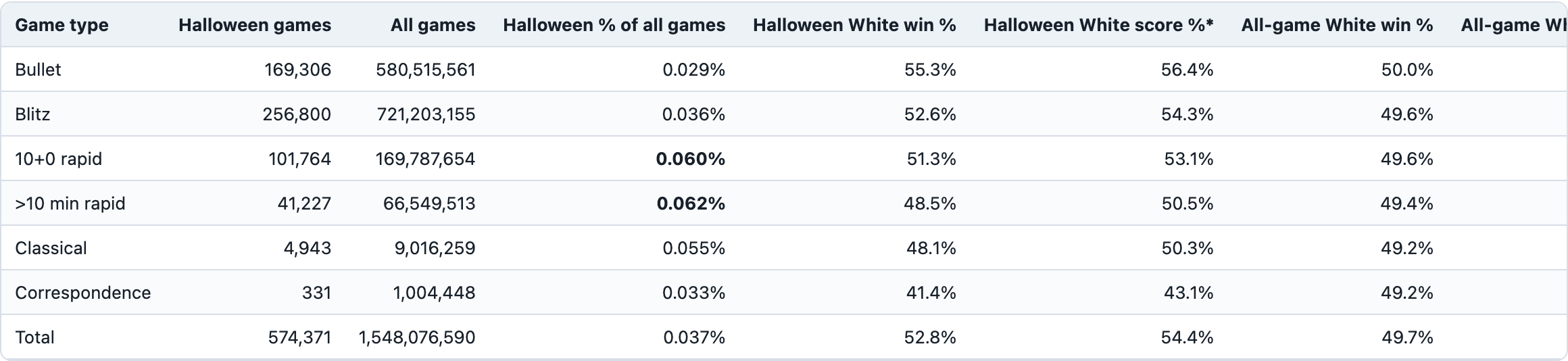
- In terms of sheer game counts the opening is concentrated in the shorter game formats. However as a percent of games played by type it is 2x more prevalent in 10+0 rapid than bullet, which is ironic given its effectiveness appears to be higher in the shorter formats.
Discussion
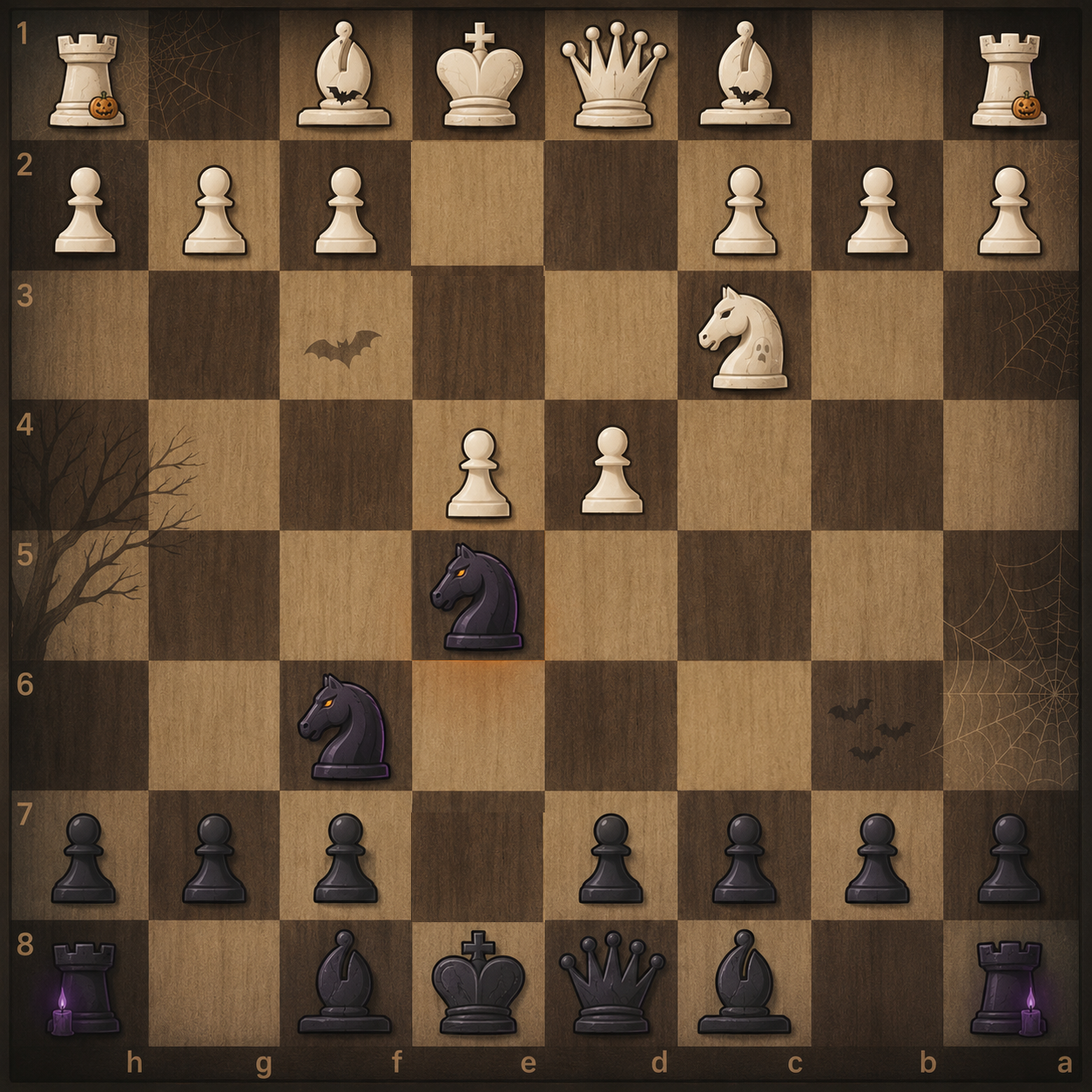
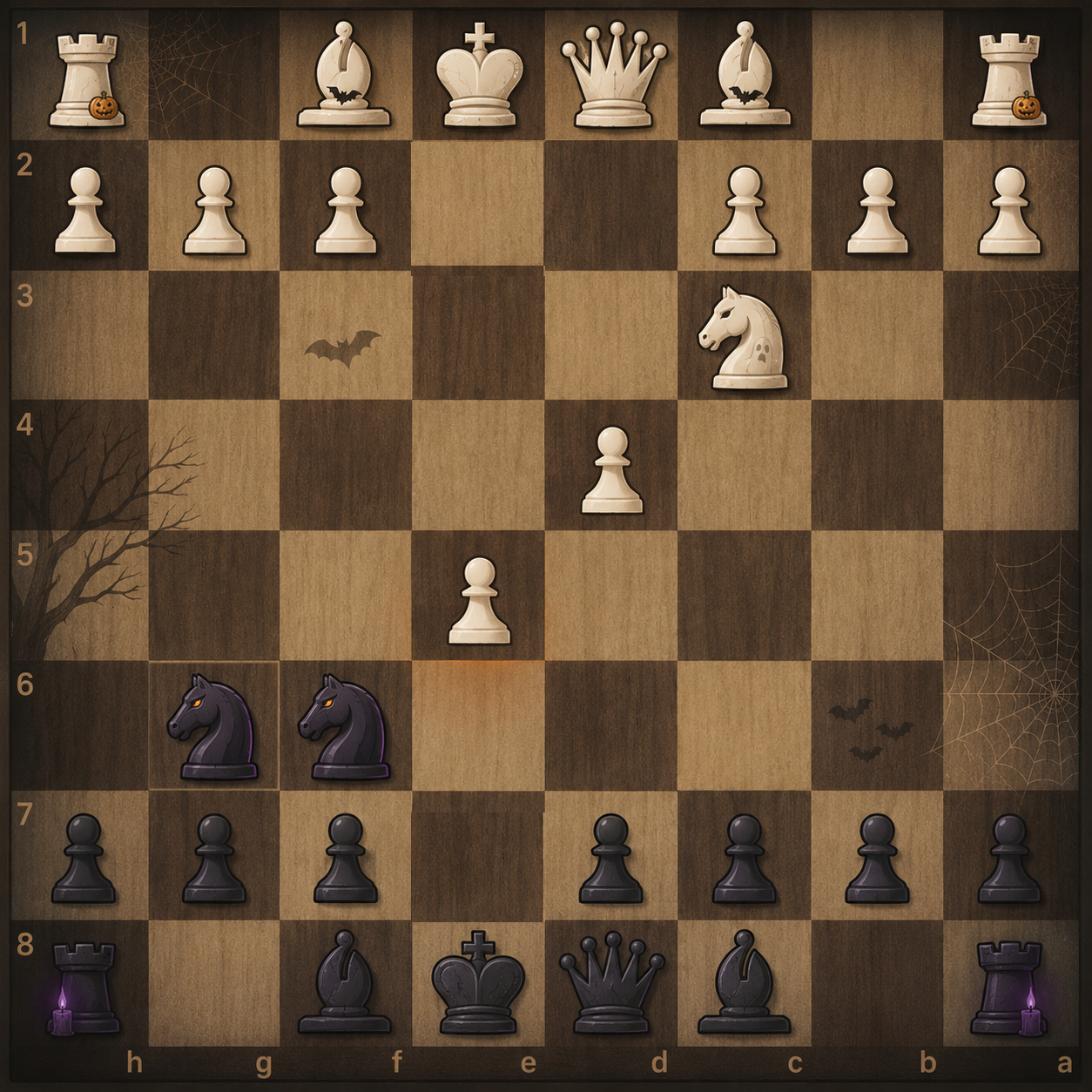
The Halloween Gambit is a rare, aggressive and apparently effective sacrifice. Looking at every eligible rated standard game played on Lichess.org from January 2025 through the end of May 2026, the setup was available for players in 1.04% of eligible rated games. White actually played the gambit 3.6% of the time it was available. In the sample of 1.55 billion games, the Halloween Gambit was played about 3.7 times for every 10,000 games seen.
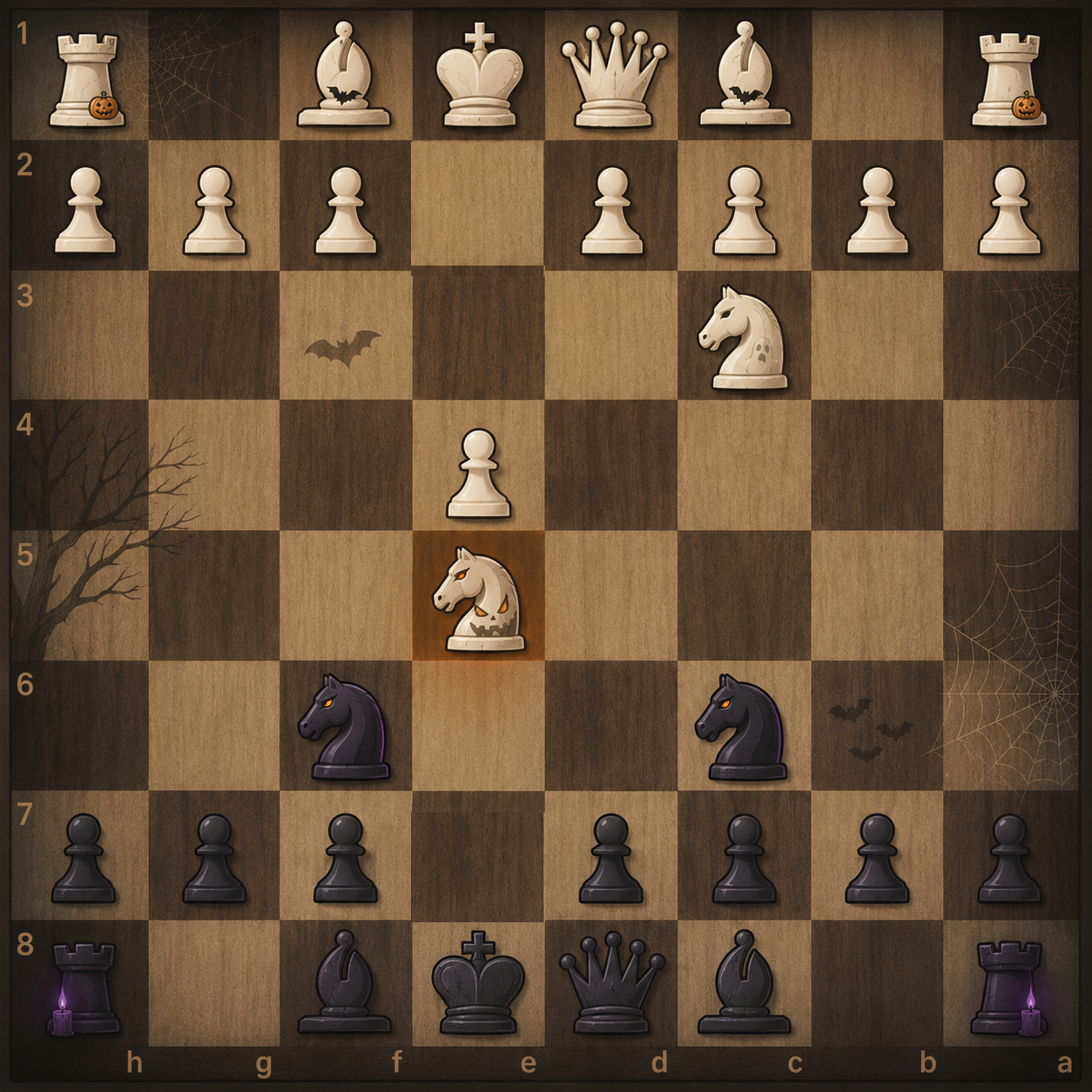
The conditions are straightforward: the e-pawns come out, and all four knights come out, in no particular order. At that point White can take the black pawn on e5, sacrificing a knight and giving us the setup in Image 1. The standard move-order is 1.e4 e5 2.Nf3 Nc6 3.Nc3 Nf6 4.Nxe5, but the same position can be reached through several Four Knights move orders.
If Black accepts, Black may feel rather good about White's foolishness for a second, only for White to start throwing pawns, pieces, and initiative at the center and kingside. Image 2 illustrates the predicament after Black takes and White pushes the d-pawn to d4. Image 3 illustrates Black's proper response to escape the first attack and White's follow-up pawn attack. After that, Black often has to tuck the knight on f6 back to its starting square, and a wave of lack-of-development gloom comes over the player.
That is part of why the opening can be uncomfortable in practical online games. Black often has to make moves that feel wrong to newer players, such as retreating a knight to its starting square or giving back a central pawn to open lines and bring more pieces into the defense. Those ideas may be objectively sensible, but they are not obvious when the clock is running and White's pawns are already rolling forward.
The opening also has a real YouTube footprint. For example, these Shorts (one, two) discuss the Halloween Gambit, and Nelson Lopez describes it as common at certain Elos. In the Lichess data analyzed here, that does not appear to be the case at the platform-wide level. It is possible that it is far more common in certain Chess.com beginner/intermediate pockets, even if it is not common across the full Lichess archive.
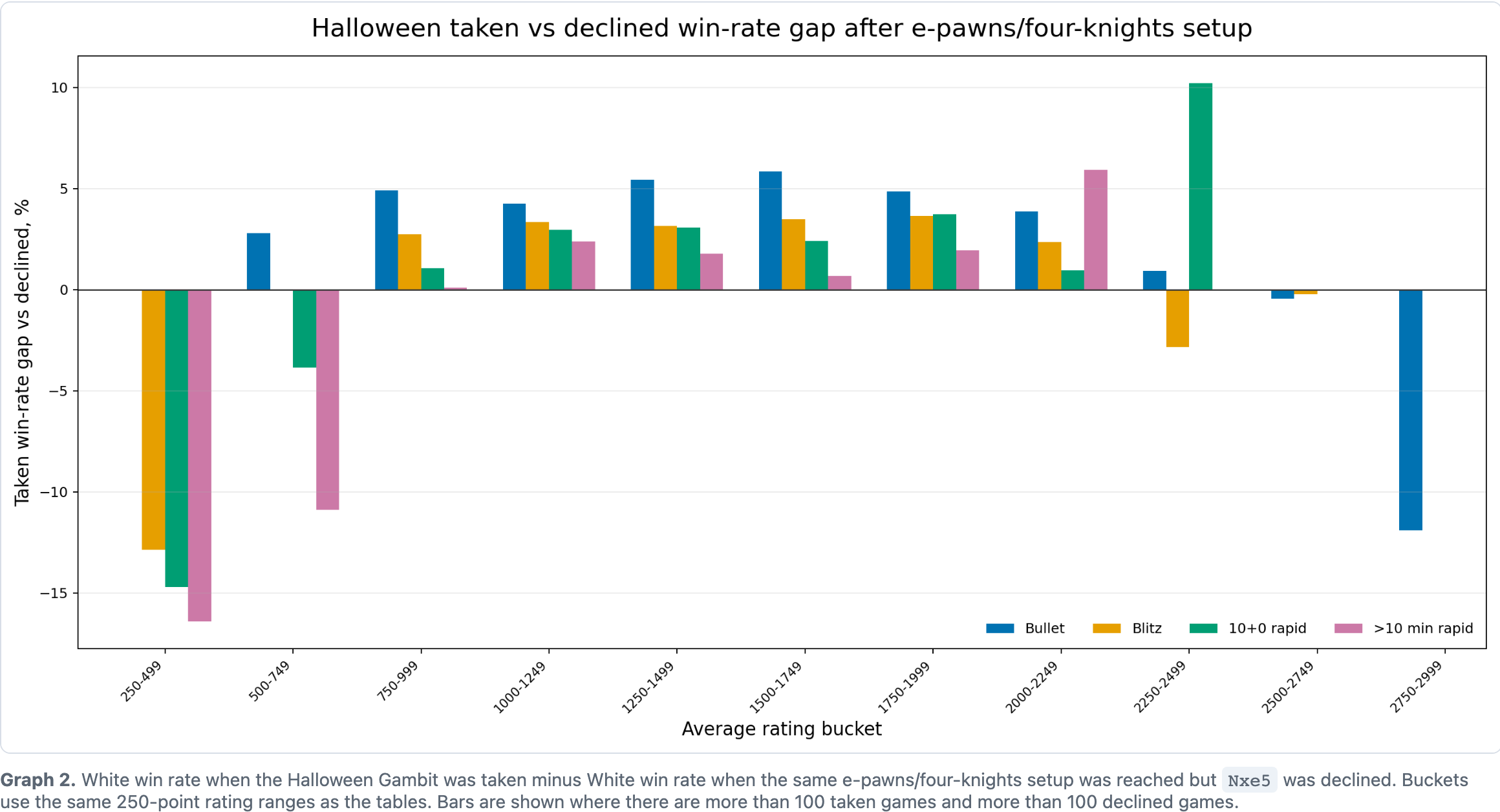
In addition to being rare, the Halloween Gambit appears effective in this dataset. Comparing the average score and win rates when it is used to similarly weighted samples of the entire Lichess rated game database, or to games where the e-pawns/four-knights setup was present but the sacrifice was not made, we see higher average scores and win rates. This is especially true for bullet and blitz in the 1000-1750 Lichess Elo range. For example, in bullet games with average Elo 1500-1749, the win-rate gap for gambit taken (30,252 games) versus declined (810,689 games) was +5.8%.
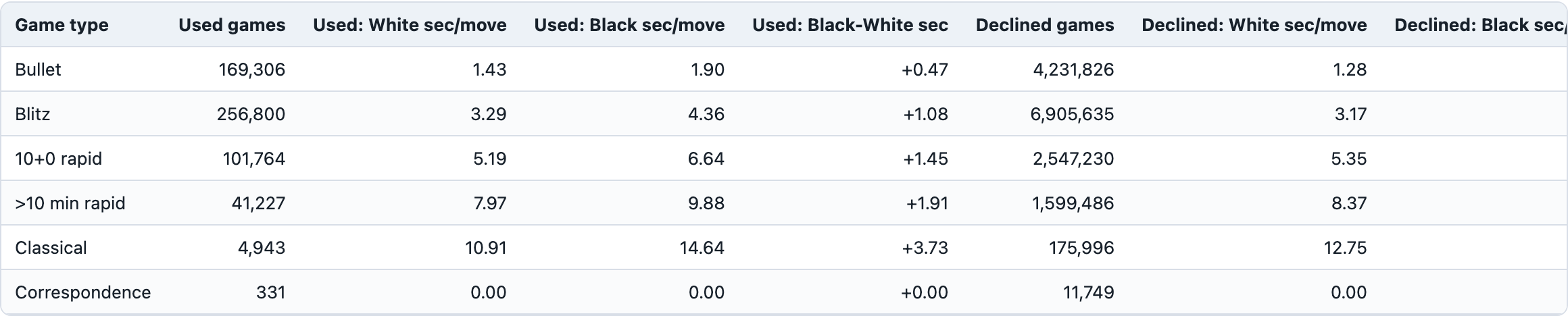
We also see that it is rare enough to spin up the CPU fans of many Black opponents who snap out of opening auto-pilot to consider what is happening. For example, in bullet games Black averaged 1.47 seconds per move in the first 10 moves with the e-pawns/four-knights setup when the Halloween Gambit was declined, and 1.90 seconds per move when used. That is a total difference of 4.3 seconds across the first 10 moves. For blitz it appeared to add 7.9 seconds.
The tables and graphs that follow provide a more detailed analysis of its occurrence, effectiveness and impact on time forfeits and opening time usage.
Data and method
I used the Lichess open database standard rated archives for January 2025-May 2026, covering 1,564,366,882 games in a large database scan. Lichess publishes these monthly PGN files under CC0 and notes that each monthly file is not cumulative.
The main analysis uses explicit PGN-prefix parsing rather than Lichess opening names. I counted a Halloween game when the e-pawns and all four knights reached the Four Knights setup in the first three moves by each side, and White then played Nxe5 as the fourth White move. Games with WhiteTitle or BlackTitle equal to BOT were excluded. No engine analysis was used.
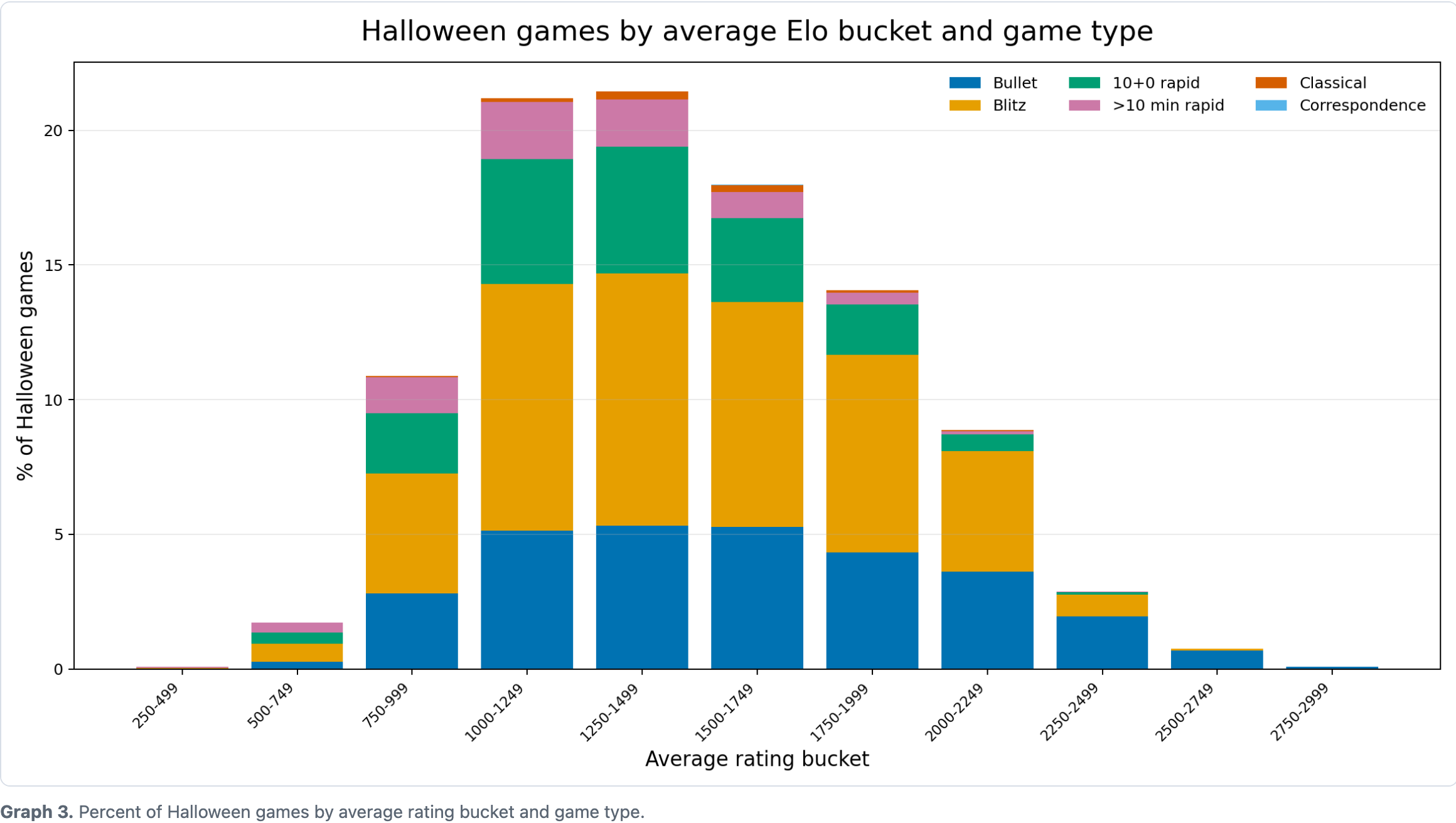
For bucket charts, I used the average of White and Black Lichess ratings and rounded down to the nearest 250-point bucket. The reference tables use the same buckets and game types across all non-bot games, reporting separate White and Black win rates.
Win-rate lift by rating bucket and game type
The first chart compares White's win rate in Halloween games against the all-game White result rate in the same game type and rating bucket. The largest lift appears in faster games and in the 1250-1999 average-rating range. Refer to the appendix for the detailed tables with the data used to construct these charts.
How often was Halloween actually available? (January 2025-May 2026 exact PGN parse)
This section answers a narrower question: how often did the opening reach the setup where White could immediately play Nxe5 to enter the Halloween Gambit?
I counted a Halloween opportunity when White's first three moves were e4, Nf3, and Nc3 in any order, and Black's first three moves were e5, Nc6, and Nf6 in any order. That includes transpositions such as 1.Nc3 Nc6 2.Nf3 Nf6 3.e4 e5. A played Halloween was then White choosing Nxe5 as the fourth White move.
One striking January 2025-May 2026 result is that declining the gambit from the e-pawns/four-knights setup was associated with lower average results for White. White scored 51.8% and won 49.6% when the Halloween was available but not played, compared with 54.4% score and 52.8% wins when White chose Nxe5. That does not prove the sacrifice is objectively best, because players self-select into openings, but it does suggest that in practical Lichess games the players who take the shot do better than the players who reach the same moment and choose a quieter move.
Breakdown by game type
This side-by-side table compares Halloween White against the all-game White baseline in the same January 2025-May 2026 archive set.
In absolute game count, the Halloween Gambit appears most often in bullet and blitz. As a share of games within each time control, though, it is actually more common in longer formats: 0.060% of 10+0 rapid games and 0.062% of >10 minute rapid games, compared with 0.029% of bullet games. That is about 6.0 and 6.2 Halloween games per 10,000 games in the rapid pools, even though the practical lift appears stronger in faster games where Black has less time to react.
Where Halloween games occur
Clock pressure and timeout endings
The timing analysis uses the same January 2025-May 2026 exact opportunity parse. The short version is that the Halloween appears to cost Black some opening clock time when it is played. Across exact-opportunity games, Black averaged 4.52 seconds per move over the first 10 Black moves when White played Nxe5, compared with 4.08 seconds when White reached the e-pawns/four-knights setup and declined it. White averaged 3.47 seconds per move when playing it and 3.65 seconds when declining it.
Timeout endings are mostly a bullet and blitz question, and the differences are smaller than the headline win-rate lift. The first table focuses on bullet and blitz because timeout endings are much more common there.
For opening clock use, I measured average seconds per move across each side's first 10 moves, using Lichess PGN clock comments where available.
Detailed Elo-bucket timing tables are available in the full Elo+Chess version linked above.

Weighted all-game White baseline
This controls for where Halloween games actually occur. For each game-type and rating-bucket cell, I used the all-game White win and score rate, then weighted that cell by its share of Halloween games.

Detailed appendix tables are available in the full Elo+Chess version: https://www.elopluschess.com/research/halloween-gambit/
Caveats
- The full-period frequency and success sections use explicit PGN-prefix parsing rather than relying on Lichess opening names.
- Results presented are based on Lichess.org rating buckets, not FIDE ratings and not Chess.com ratings. To understand how that may translate to Chess.com ratings, see the cross-platform Elo mapping methodology.
- These are game results, not engine evaluations. A good practical score does not prove theoretical soundness.
- Small high-rating and slow-time-control buckets should not be overinterpreted. Detailed reporting rows suppress buckets or cells with 100 or fewer Halloween games.
- The scan excludes accounts tagged as bots in PGN headers, but it does not attempt to detect untagged engine use.