
Is it time for a chess checkup?
ChessCheckup.com is a free, quick, principles-first habit check for beginner and intermediate players who want to understand what their own games say about their chess fundamentals.
Who is ChessCheckup for?
ChessCheckup is meant for players who are still turning chess principles into instincts. If you are learning to develop pieces, castle on time, keep loose pieces protected, avoid early queen adventures, manage the clock, and convert material advantages, a checkup gives you a compact way to see which principles are actually showing up in your games.
That makes the intended audience beginner to intermediate players, especially players who watch chess lessons and think: “I understand that idea, but am I doing it in my own games?”
It is not an engine review, and it is not a replacement for a coach. It is closer to a health check for your chess habits: quick, practical, and designed to point your attention toward recurring issues worth reviewing.
How it works
Chess.com
For Chess.com, go to chesscheckup.com, enter a public username, and build the checkup.
Lichess
For Lichess, use the Lichess-specific address: chesscheckup.com/lichess.
The site pulls public game history, runs the Elo+Chess feature pipeline, and summarizes measured habits in plain English. The goal is to make the first diagnostic pass simple: what are the recurring themes in your games, and which ones deserve attention next?
ChessCheckup does not ask you to choose a game type. It counts your supported public games and runs the checkup on the type you play most often. The supported buckets are 10-minute rapid, 3-minute blitz, 1-minute bullet, and longer-than-10-minute rapid. If two buckets are tied, the current tie-break order is 10-minute rapid, then 3-minute blitz, then 1-minute bullet, then longer rapid.
Stop, Start, Continue
The report is organized into three columns: Stop, Start, and Continue to. That format is deliberately simple. It is similar in spirit to a relationship counsellor helping a couple communicate: you do not always need a giant diagnosis before the conversation gets better. You need a few concrete things to stop doing, a few better habits to start, and a few strengths to keep reinforcing.
Chess improvement often works the same way. A player may not need a deep engine lecture after every game. They may need to hear: stop hanging pieces, start converting extra material, and continue using the piece-activity habits that already work.
The cutoff is intentionally simple in this first-pass checklist. For the metrics that ChessCheckup considers, the Elo+Chess engine converts the measured habit into a benchmark-style grade. The checklist cutoff is about 750 on the Chess.com-equivalent scale. If the grade is below that line, the item is treated as a candidate weakness and placed into either Stop or Start, depending on whether the better advice is to reduce a bad habit or add a good one. If the grade is at or above the cutoff, and the metric has a clear positive interpretation, it can land in Continue to.
For Lichess reports, that same cutoff is translated onto the Lichess rating scale for the selected game type. As a rough guide, a 750 Chess.com-equivalent checklist cutoff maps to about 1160 Lichess for 10-minute rapid, 1200 Lichess for 3-minute blitz, 1300 Lichess for 1-minute bullet, and 1195 Lichess for longer rapid. The player rating shown at the top of the checkup remains the native platform rating; the cutoff explanation is about how the checklist decides whether an item belongs in Stop/Start or Continue.
Example report
Here is an example report using the sample name “JoeElo750Player.” The structure is the same as a normal report: current rating context, number of analyzed games, and the Stop / Start / Continue checklist.
The small information icons throughout the checklist open tooltips with beginner-friendly context. They explain concepts such as hanging pieces, loose pieces, forks, skewers, passed pawns, castling, development, and time management so the report can double as a short learning guide rather than just a list of labels.
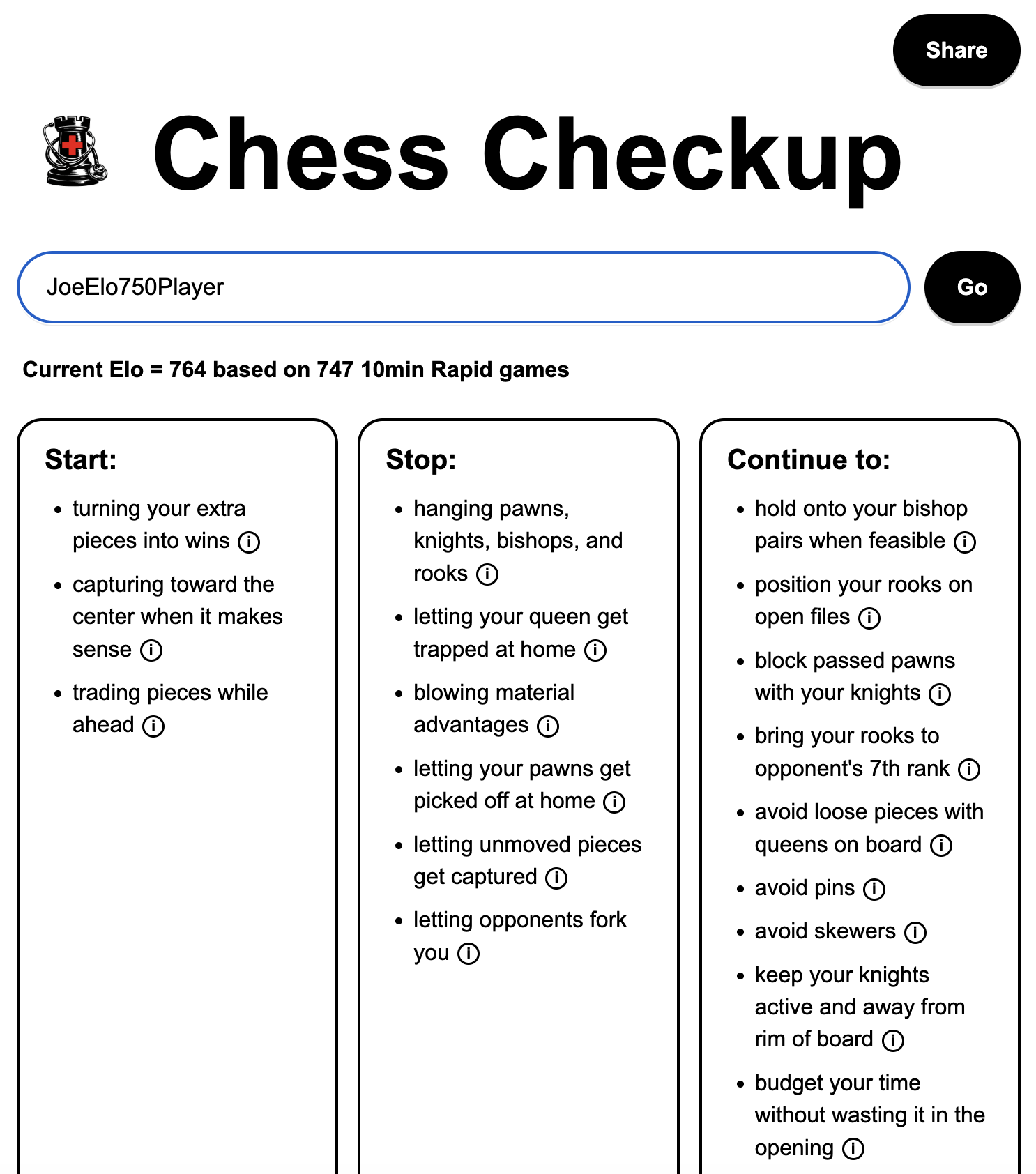
After a report is generated, the Share button creates a link to a static version of the checklist. That makes the report easy to send to a coach, parent, friend, or student without asking them to rerun the analysis.
Why principles still matter
One reason ChessCheckup exists is that chess teaching is full of practical principles that are easy to say and hard to consistently follow: develop your pieces, castle before the center opens, do not leave pieces undefended, avoid wasting opening tempi, and keep asking what your opponent is threatening.
Nelson Lopez has a useful version of this style of teaching in 35 Vital Chess Principles | Opening, Middlegame, and Endgame Principles. It is exactly the kind of material ChessCheckup is designed to complement: watch the lesson, then use your own games to see which principles are leaking.
The internet has many good principle-first chess resources. A few adjacent examples worth knowing:
A broad tour through opening, middlegame, and endgame principles.
A classic beginner-to-club-level theme: loose and undefended pieces drive a huge amount of tactical pain.
A habit-based improvement series that lines up naturally with checkup-style diagnostics.
A fast-moving principles and concepts video for players trying to build a more reliable chess checklist.
The Elo+Chess engine underneath
ChessCheckup is a lighter, more focused entry point built on the Elo+Chess reporting engine. Elo+Chess computes game-history metrics from public games and compares player habits against benchmark curves built from large samples of public chess games across the rating spectrum.
That matters because raw numbers are often hard to interpret. If you moved your queen before move 10 in 38% of games, is that normal for your level? If you failed to castle in many losses, is that unusual? If your loose-piece exposure is high when queens remain on the board, is that a likely tactical weakness? The Elo+Chess engine tries to turn those measurements into context.
For more background, see the longer Elo+Chess article: Your Chess Teacher Was Right: We Analyzed 1.3 Billion Games To Prove It.
What the checkup looks for
The exact mix of metrics varies with the available game history, but the broad diagnostic themes include:
- Opening discipline: development, repeated piece moves, early queen moves, and whether the opening leaves you coordinated.
- King safety: castling behavior, delayed castling patterns, and exposure when the center starts to open.
- Tactical awareness: loose pieces, hanging pieces, forks allowed, and vulnerability while queens remain on the board.
- Piece coordination: connected rooks, minor-piece activity, and whether your pieces are working together.
- Material and conversion: whether advantages are being converted or handed back.
- Time use: opening and middlegame clock patterns that may be creating practical problems.
What it is not
A checkup should not be read as causal proof. If the report says a habit is associated with your losses, that does not mean the habit alone caused those losses. It means the pattern appears often enough in your games to be worth reviewing.
It also does not replace looking at actual positions. The best use is to treat the report as a triage tool: pick one or two recurring themes, review the games behind them, and then train the principle deliberately.
Try it
If you mainly play on Chess.com, start here: https://www.chesscheckup.com.
If you mainly play on Lichess, use: https://www.chesscheckup.com/lichess.
The useful question is not “what was my worst move?” The useful first question is often simpler: “Which chess principles do my own games show I have not turned into habits yet?”